Peridot, zoisit sau smarald: cum deosebești o piatră verde și cum o porți într-un inel
Peridot, zoisite or emerald: how to tell a green stone and how to wear it in a ring
Piatra verde dintr-o bijuterie poate fi peridot, smarald, zoisit, turmalină sau alta. De la distanță arată bine toate; diferențele apar la duritate, la felul în care reacționează la lovituri și la ce se întâmplă cu ea după câțiva ani de purtat. Pe scurt, ce merită știut despre cele trei nume pe care le caută cei mai mulți: peridot, zoisit și smarald.
Ce înseamnă „piatră naturală”
O piatră naturală s-a format în pământ, nu într-un laborator, și are ceea ce mineralogii numesc incluziuni: fire, fisuri mici, bule, culori care nu sunt uniforme. Ele nu sunt un defect de ascuns. La unele pietre, incluziunile sunt chiar semnătura lor. Exact de aceea două pietre din același mineral nu arată la fel, iar două piese cu „aceeași” piatră verde sunt, de fapt, diferite.
În colecția Hudei Mahdi, pietrele naturale stau alături de perle, într-un cadru de sârmă de argint. Nicio piesă nu se repetă, iar piatra e adesea cea care hotărăște desenul din jurul ei.
Duritatea: o scară utilă, dar nu totul
Duritatea unei pietre se măsoară pe scara Mohs, de la 1 la 10. Ea arată cât de greu se zgârie piatra. Valorile uzuale: peridotul are în jur de 6,5–7, smaraldul 7,5–8, iar zoisitul (din care face parte și tanzanitul) 6–7.
Pe hârtie, smaraldul pare câștigătorul. În practică, nu e atât de simplu, pentru că duritatea nu e tot una cu rezistența la lovituri. Smaraldul are de obicei multe incluziuni, iar o lovitură de colț îl poate crăpa mai ușor decât ne-am aștepta după cifră. Un peridot, mai puțin dur, se zgârie mai repede de praful de zi cu zi, dar suportă mai bine un șoc mic.
Concluzia practică: un inel purtat zilnic, care atinge birouri și clanțe, cere o piatră și o montură alese cu grijă. Un colier sau un pandantiv, care stau departe de lovituri, iartă mult mai mult.
Cele trei, pe scurt
**Peridotul** are un verde de măslină, uneori spre galben. Nu cere tratamente pentru culoare și se potrivește bine cu argintul. Se zgârie mai ușor decât smaraldul, deci un inel cu peridot cere puțină atenție.
**Smaraldul** e verdele „adânc”, cu incluziuni care, la smarald, sunt chiar așteptate. E mai dur pe scară, dar mai fragil la lovituri. Multe smaralde sunt tratate cu uleiuri pentru a li se estompa fisurile, motiv pentru care nu se curăță în ultrasunete sau cu abur.
**Zoisitul** e un mineral cu mai multe fețe: tanzanitul albastru-violet e zoisit, dar există și zoisit verde, adesea cu pete roz sau negre. Se poartă bine, însă nu suportă schimbări bruște de temperatură.
Cum se leagă asta de piesele de pe site
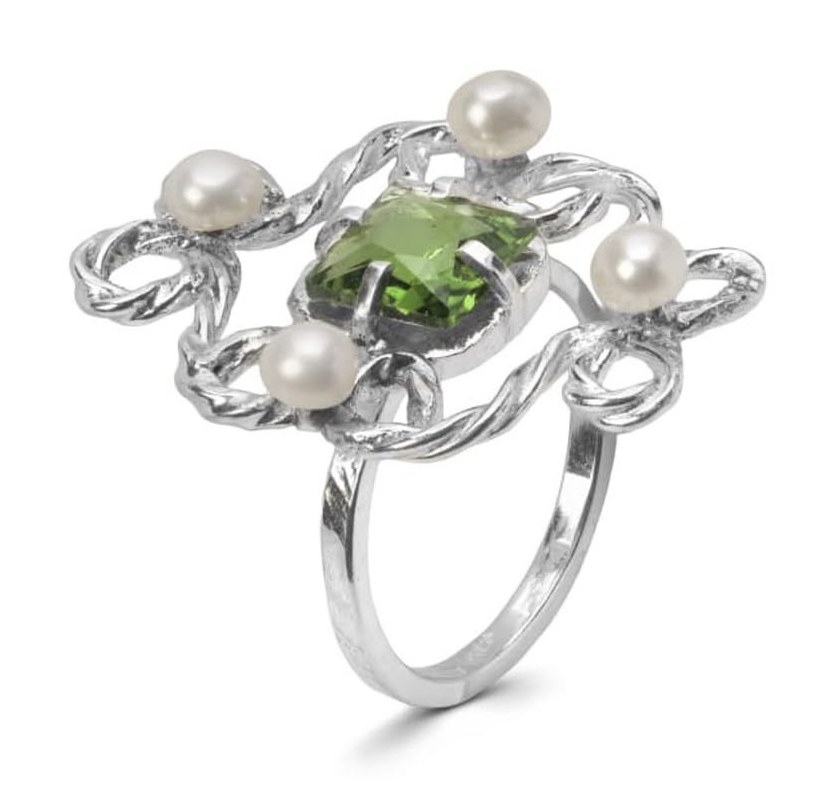
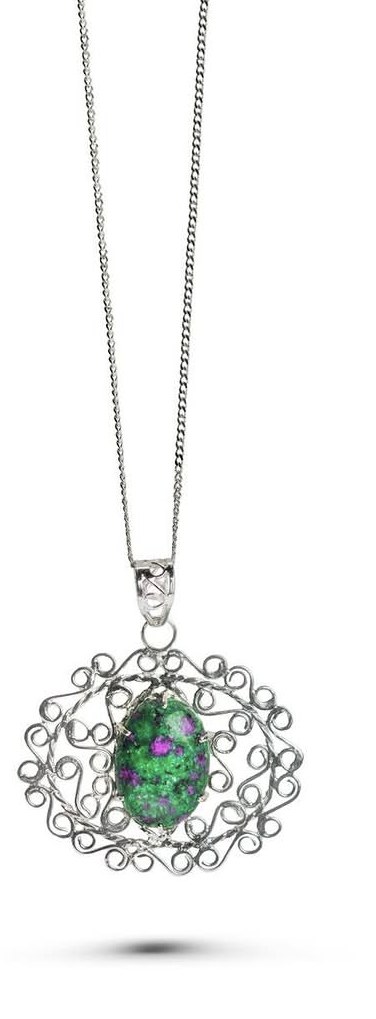
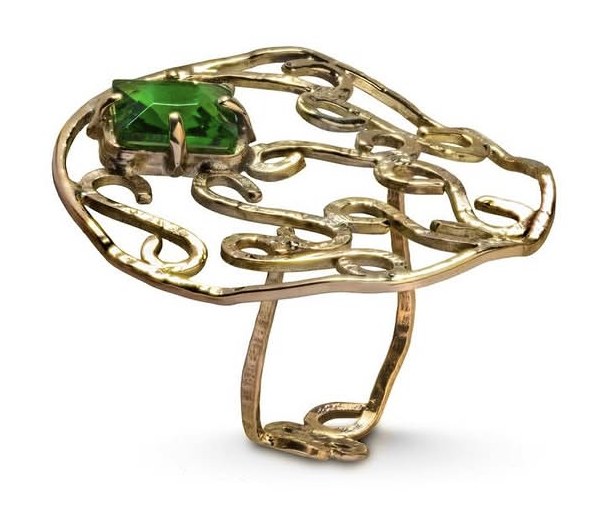
Pe site, pietrele verzi sunt descrise așa cum se văd, nu cu numele mineralului: inelul cu piatră verde are o piatră verde fațetată în mijlocul unui cadru de sârmă răsucită, cu patru perle în colțuri; inelul auriu poartă o piatră verde dreptunghiulară, descentrată; pandantivul cu piatră verde are o piatră cu incluziuni roz și negre, într-o rozetă de spirale de argint; brățara-inel are o piatră verde pestriță în mijlocul palmei.
Numele exact al fiecărei pietre îl știe Huda. Dacă vrei să afli ce piatră e într-o anumită piesă, o poți întreba direct, pe Instagram, înainte să alegi.
Ce să alegi, dacă ai de ales
Dacă vrei un inel pe care să-l porți în fiecare zi, întreabă ce piatră e, cât de adânc e ținută în montură și cum se îngrijește. Dacă vrei ceva de purtat mai rar sau în afara loviturilor, un pandantiv ca acesta cu piatră verde sau un colier te lasă să alegi după culoare, nu după duritate.
În orice caz, evită schimbările bruște de temperatură, produsele de curățat cu clor și curățarea în ultrasunete înainte să afli ce piatră ai. Pentru argintul din jurul pietrei, vezi și cum îngrijești bijuteriile din argint.
The green stone in a piece of jewellery might be peridot, emerald, zoisite, tourmaline or something else. From a distance they all look good; the differences show up in hardness, in how the stone reacts to knocks, and in what happens to it after a few years of wear. Here is what is worth knowing about the three names people search for most: peridot, zoisite and emerald.
What "natural stone" means
A natural stone formed in the earth, not in a lab, and it carries what gemmologists call inclusions: threads, tiny fractures, bubbles, colour that is not even. They are not a flaw to hide. In some stones the inclusions are the signature. That is exactly why two stones of the same mineral never look alike, and why two pieces with "the same" green stone are in fact different.
In Huda Mahdi's work, natural stones sit beside pearls inside a frame of silver wire. No piece repeats, and the stone is often what decides the drawing around it.
Hardness: a useful scale, but not everything
The hardness of a stone is measured on the Mohs scale, from 1 to 10. It tells you how hard the stone is to scratch. Typical values: peridot sits around 6.5–7, emerald 7.5–8, and zoisite (the family tanzanite belongs to) 6–7.
On paper emerald wins. In practice it is not that simple, because hardness is not the same as toughness. Emerald usually carries many inclusions, and a knock on a corner can crack it more easily than the number suggests. Peridot, softer, scratches faster from everyday dust but takes a small shock better.
The practical conclusion: a ring worn every day, brushing desks and door handles, calls for a carefully chosen stone and setting. A necklace or pendant, kept away from knocks, forgives much more.
The three, briefly
**Peridot** is olive green, sometimes leaning yellow. It does not need treatment for colour and sits well with silver. It scratches more easily than emerald, so a peridot ring needs a little attention.
**Emerald** is the "deep" green, with inclusions that are simply expected in emerald. It is harder on the scale but more fragile to knocks. Many emeralds are treated with oils to soften the look of fractures, which is why they should not go in an ultrasonic cleaner or near steam.
**Zoisite** is a mineral with several faces: blue-violet tanzanite is zoisite, but there is green zoisite too, often with pink or black patches. It wears well, but does not like sudden temperature changes.
How this connects to the pieces on the site
On the site, green stones are described as they look, not by the name of the mineral: the green stone ring holds a faceted green stone at the centre of a twisted wire frame with four pearls at the corners; the gold ring carries a rectangular green stone set off-centre; the green stone pendant has a stone shot through with pink and black inside a rosette of silver spirals; the hand chain has a mottled green stone at the back of the hand.
Huda knows the exact name of each stone. If you want to know which stone is in a given piece, you can ask her directly on Instagram before you choose.
What to choose, if you have to choose
If you want a ring to wear every day, ask which stone it is, how deep it sits in the setting and how to care for it. If you want something for less hurried days, a pendant like this green stone one or a necklace lets you choose by colour rather than by hardness.
Either way, avoid sudden temperature changes, chlorine cleaners and ultrasonic cleaning until you know which stone you have. For the silver around the stone, see also how to care for silver jewellery.
You can see all the stones of the collection on the pieces page.